
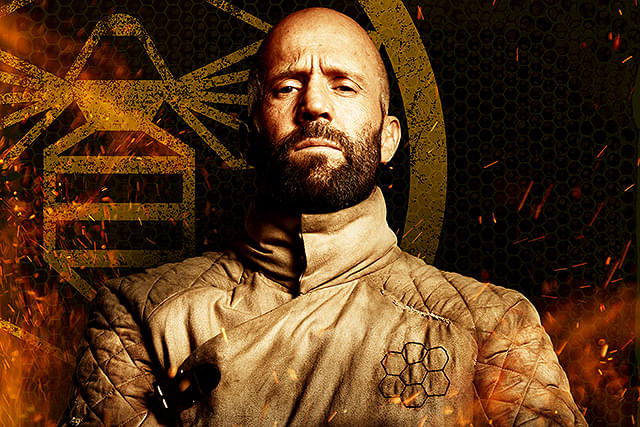
“Working Man,” starring Jason Statham and directed by David Ayer, was released this past January. The first time these two collaborated was on the action thriller “The Beekeeper,” which was released in Japan about a year ago. The screenplay for that film was written by Kurt Wimmer, who also wrote “The Reckoning” (2002).
Statham plays Adam Clay, a beekeeper living a quiet life in rural America. His days are spent raising bee colonies and harvesting honey. Clay lives on the farm of Eloise Parker (Phillisia Rashad), a retired teacher, and feels indebted to her.However, one day, Parker suddenly loses her entire fortune to a fishing scam and takes her own life. Clay rises to avenge his benefactor and settle the score. He is a former agent of the elite secret organization “The Beekeepers,” and using their intelligence network and skills, he relentlessly tracks down the fraud ring.
Action that feels like a horror movie
“The Beekeeper” is a vigilante film in which the protagonist takes revenge on a criminal organization outside the bounds of the law; it also falls into the same lineage as the “John Wick” series (2014–), featuring the classic trope of “the opponent who underestimated him turns out to be a killing machine.”Furthermore, just like in his previous films, Statham’s character here is a taciturn, unsmiling, and invincible man. Given that, some might think this is a predictable film with little to offer.
However, the highlight of this film lies in the fact that various elements are taken to the extreme. That excess goes beyond what we could have imagined. It’s surprising that director David Ayer, known for his realistic, hard-hitting crime action films, has made an action movie that could be described as absurd.
First off, Statham’s character, Clay, is practically invincible throughout the film, transcending the typical action hero. While “The Beekeeper” is supposed to be an agent who eliminates targets to restore order when society breaks down, as Statham himself notes in the production notes, he “appears like a ghost to guide the world in the right direction.” At times, his presence is depicted exactly like a ghost, making the film feel less like an action movie and more like a horror film.
For example, the opening scene where he captures a hornet and electrocutes it resembles the entrance of a monster or serial killer in a horror film. This likely serves as a metaphor for the story’s future direction—that he will show no mercy to villains. True to form, Clay relentlessly and thoroughly corners the fraud ring.During the fight in the farm barn, the expressions of the scam group, gradually turning pale with fear, are even more striking than Statham himself. In the elevator, a trained soldier tries to escape but is pulled in and brutally killed.
Wallace, the former CIA director played by Jeremy Irons, says, “If the Beekeeper tells you to ‘die,’ you have no choice but to die.”In this film, Statham is portrayed almost like a ghost or monster from a horror movie. While the villains who fear Statham meet a tragic end, *The Beekeeper* is a straightforward tale of good versus evil, leaving no room for sympathy toward the villains in the story.
A Symbol of the Good Old Days of America and the Darkness of the Modern World
The distinction between good and evil is also unusually clear-cut by today’s standards. There are the honeybees that must be protected and the hornets that must be exterminated. The elderly—who own farms and continue to participate in charitable activities even after retirement, serving as the very conscience of the “good old America”—are indeed the honeybees. The fact that the car Clay drives on the farm is a rusty Ford F100 also serves as a symbol of the elderly and the “good old America.”
On the other hand, there are those who prey on the elderly—the very people who have supported America. Derek (Josh Hutcherson), the ringleader of the scam group, is an unquestionably evil man who takes the blame-shifting mentality to its extreme. Lazarus (Taylor James), the mercenary sent to take down the Beekeeper, wears yellow clothing and attempts to stab Clay not only with a gun but also with a knife, portrayed much like a hornet.
The hornets, deemed evil and in need of extermination, are also overly stereotyped. The fraud ring’s workplace is lit up in neon colors, with four-on-the-floor beats blaring—it’s practically a nightclub. Elsewhere, elements like yoga and sushi even make an appearance, creating a sense that the film is forcing upon us things incompatible with the image of “good old America”—things that lie outside that image—making it feel overly formulaic.
Furthermore, the pace of the story accelerates excessively and at an ever-increasing rate. Statham doesn’t stop until he corners his enemies and exacts his revenge. Consequently, the groups trying to defeat or stop him—the scam artists, mercenaries, the FBI, and SWAT—keep multiplying. The climactic scene where they all converge at once to confront Statham on a narrow staircase is spectacular.
What’s even more impressive is that, amidst the chaos of so many people on those stairs, Clay—the “Beekeeper”—instantly discerns who the villains are, subdues the SWAT team without killing them, and systematically takes out only the mercenaries aligned with the con artists. Amidst the action unfolding at a breakneck pace, Clay accurately eliminates only the villains—the “hornets.”While the story is a straightforward tale of good versus evil, the distinction between good and evil is physically nuanced.
As the pace accelerates and the action becomes more intense, the music and sound seem to remain constant from the midpoint onward; perhaps because of this, the sudden off-beat moments stand out even more. After the fierce combat, during the climactic action scene in the narrow passageway, the music abruptly stops. The momentary silence that follows is unforgettable.It’s a simple yet effective touch.
Another offbeat moment comes early on, when one member of the scam ring is tied to a Ford F-100 and dragged into the sea. The way he’s yanked by the truck and flung into the water is cruel, yet unlike the bloody scenes, it has a certain comical quality—which is why it leaves a stronger impression than even Statham’s physical action sequences.I suspect the 1967 Ford F-100 symbolizes the “good old days” of America—and by extension, the elderly—but this scene of the scam artists being dragged into the sea seemed to be imbued with the vengeful spirit of the victims who had been deceived and exploited.
Incidentally, screenwriter Kurt Wimmer’s aunt was actually scammed out of her bank account and reportedly died penniless. This incident served as the catalyst for the story of *The Beekeeper*. In the production notes, Wimmer states, “It makes me incredibly angry when I see people preying on the elderly.”
The hornets trying to prey on the honeybees that have supported society, and the beekeeper trying to eliminate the hornets and protect the honeybees. This extreme and far-fetched story is rooted in real-world social issues.